

Blog / Sunday June 7, 2026
7 Proven Blog Title Tips to Increase Organic Traffic

Looking for better blog titles that attract more clicks and increase organic traffic? The key is creating headlines that match search intent, include relevant keywords, and immediately show readers the value of your content. Even the most informative article can struggle to generate traffic if the title fails to capture attention in search results.
A strong blog title helps improve click-through rates (CTR), supports SEO efforts, and encourages readers to choose your content over competing pages. Let’s check out proven techniques for writing catchy blog titles that attract more visitors, improve search visibility, and help your content reach the right audience.
Do Your Keyword Research
It is vital to perform keyword research before you construct your blog post headline. You will be surprised how often people use rather different terminology than you expect. Therefore, you need to be sure to select the keywords that get the highest search volumes. Including the right keyword in your blog post title will impact your SEO ranking and help you increase the CTR (Click-Through-Rate).
You could use several useful tools to research keywords, such as Google Keyword Planner, Ahrefs Keyword Explorer, Semrush Keyword Research, and more.
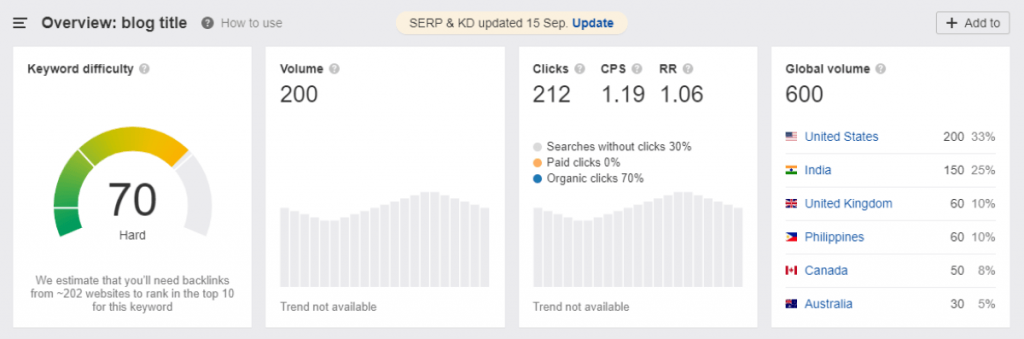
Another recommended SEO practice is to place the keyword(s) near the beginning of your title. It is proven that keywords positioned at the start of the post headline tend to attract readers’ attention.
Keep It Short
While there is no strict rule for a recommended blog post title length, it is always a good idea to keep it short and be specific. Certainly, there will be times when you have a great and creative idea for a headline; however, always keep in mind that you should try to avoid using non-essential words in it. As we previously mentioned, users typically search the web with a specific intention and look for the exact answer that will most likely answer their inquiry.
Furthermore, it would be best if you always strived to keep your blog title below 50-60 characters; either way, the full title will not be displayed in search results. Google currently displays titles that max out at 600 pixels, which is around 50-60 characters. If your heading is cut off, you risk negatively impacting your traffic volumes.

It is also proven that shorter titles tend to get more Social Media likes and shares. Therefore, you can be sure that you could never go wrong with a straight-to-the-point title.
Stay Accurate
It is important to set clear expectations in your blog post title and, of course, to fulfill them. A clear blog title will indicate the question answered in the content. As already mentioned, users make informed decisions to click on your blog post based on its title. Hence, they expect to find relevant content.
According to HubSpot’s research, blog headlines that include a classification type, such as [Interview], [Podcast], [Infographic], etc., perform 38% better compared to titles without clarification.
Avoid Misleading Titles
No one likes to be misled. It is vital to ensure your content matches the title. As we previously pointed out several times, readers come with certain expectations, and if they fail to address them, they will be disappointed. This will potentially lead to a negative user experience and loss of their trust, which will lead to the loss of readers. You should aim to avoid exaggerating your blog headlines unless you are certain your content will meet the user’s expectations.
For business-oriented websites, quality over quantity is the key. If you stretch the truth, this will likely result in higher bounce rates, which is not the general idea here. Your goal is to keep your readers and potentially convert them.
Make It Attractive
Even though it is recommended to keep your blog titles accurate, it does not mean you need to be stiff. You can still put your creative thinking to work and come up with something clever and excellent. The importance of knowing your audience should not be underestimated in this direction. As usual, the proven way to ‘click’ with your readers is to understand the language they speak.
To come up with a truly catchy title, you will need to experiment. You can try using phrases that appeal to emotions, wherever suitable, of course. Using terms that evoke emotions, such as surprise, delight, hate, even, can help you stand out.
Write Multiple Titles
Once you take all the above advice into account, it is time to start brainstorming for ideas. Try to come up with several suitable titles for the blog post. Then examine them and take the best of each one to form the perfect headline. Writing is a creative process, so even if you follow all the technical tips, you could get stuck sometimes. Rushing yourself is not gonna help much. You may even consider asking for a third-party opinion. Of course, it is important to rely on someone experienced in the field. Last but not least, you can try some online sources for blog title ideas, such as Free AI SEO Title Generator, HubSpot Blog Ideas Generator, and Tweak Your Biz.
Stick to the Blog Posts Title Formulas That Work
Several blog title templates are proven to really work to your advantage. Many specialists have performed research over the years, and there were clear indications that some title structures tend to attract readers more than others. As a bonus to our blog post, we have chosen the best ones (in our humble opinion) for you.
- How to ___ that drives ___.
- How to ___ in [#] easy steps.
- How to find ___.
- How to change ___.
- How to create ___ that gets ___.
- How to tell if ___.
- How to ___ the right way.
- How to get rid of ___.
- Where to find ___.
- A complete guide to ___.
- Beginners guide: ___.
- [#] ___ to consider for ___.
- [#] types of ___.
- [#] useful ___ for ___.
- [#] rules for ___.
- [#] ideas for ___.
- [#] best ___ for ___.
- [#] essential things for ___.
- [#] key benefits of ___.
- [#] smart strategies for ___.
- [#] effective tactics to ___.
- [#] essential steps to ___.
- [#] wrong ways to ___.
- [#] ways to make sure your ___.
When you incorporate all the tips we have provided in this article, do not forget how important it is to track your website metrics. You can gain accurate information on how your blog posts perform and which practices work for you.
Now we expect you to be already excited to start your blogging journey and come up with even catchier titles? If you are already convinced, you are one step away from starting to excite your readers. Here comes our part, as a fully managed web hosting provider, we support various blogging applications, such as WordPress, Joomla, Drupal, Ghost, and more. The best part is that we can set up everything for you and get you to the point where you will be ready to start writing your blog posts and amaze the Web with what you have to say. Supposing you are already eager to start, make sure to check out our hosting plans.
FAQs
Aim for 50–60 characters when possible. This helps prevent title truncation in Google search results while keeping the headline clear and compelling.
Yes. Including your primary keyword in the title helps search engines understand your content and can improve visibility for relevant searches.
In many cases, yes. Numbered headlines such as “7 Tips” or “10 Ways” often attract more attention because they set clear expectations for readers.
Yes. Updating an underperforming title to better match search intent, include stronger keywords, or increase relevance can improve CTR and lead to more organic traffic over time.
