

Crawlers / Saturday December 27, 2025
How Commercial and SEO Crawlers Improve Your Web Strategy
Commercial web crawlers gather market data across multiple websites while SEO bots audit your own site for technical issues. Understanding how both work together creates a stronger, smarter web strategy that improves your search visibility and competitive edge.
Unfortunately, many website owners rely solely on SEO crawlers to fix their site’s technical problems and overlook the broader landscape. But in reality, a strategic combination of both crawler types provides full-spectrum insight. Their combination turns raw data into actionable decisions that improve rankings, traffic, and business outcomes.
This guide shows you when to use each type, how they complement each other, and why your hosting environment matters for both.
Difference Between Commercial Web Crawlers and SEO Bots
Mistaking commercial web crawlers for SEO bots is a relatively common mistake non-specialists make. In our experience, these two are usually considered the same by website owners, who are just starting to introduce themselves to the indexing power of their website. Though the two groups share common behavior on the surface, they help users with two very different tasks.
A clear view of their differences sets the right expectations before you start working with any tool.
| Commercial Web Crawlers | SEO Bots |
| Collect broad sets of data for many business needs | Focus on ranking signals and site performance |
| Scan large groups of websites | Scan your own site for problems that affect SEO |
| Used for research, monitoring, and analysis | Used for audits, indexing checks, and content reviews |
| Produce large datasets and wide insights | Produce clear SEO reports and recommended fixes |
| Used by marketing teams and data analysts | Used by website owners, SEO teams, and freelancers |
| Often more complex to configure | Usually easier for beginners to set up |
Commercial Web Crawlers
Commercial web crawlers scan large sets of pages to collect data for many business tasks. They help companies track trends, monitor competitors, or analyze market behavior. Naturally, they work at scale and gather information from many sources without slowing down.
You can think of them as market research teams that collect data from many places to reveal patterns and useful insights. This ensures businesses make data-driven decisions based on facts rather than gut feelings.
For example, a company may use commercial web crawlers to track product prices, follow industry changes, or watch how content spreads across the web.
These bots cover vast areas and support work that reaches far beyond SEO. Many teams depend on them when they need reliable information from different corners of the internet.
SEO Bots
SEO bots focus on how your own website behaves. They scan your pages the same way search engines do and highlight issues that affect your rankings. Their reports show broken links, poor metadata, slow pages, and other problems that need fast attention.
You can picture them as inspectors who check how each part of your site works and how it appears to search engines. Their goal is simple. They help you remove obstacles that prevent your pages from reaching their full potential.
As a result, these bots support technical SEO and give direct insight into what needs improvement. They help you understand how search engines read your content and how well your pages serve your visitors.
So, a clear view of these two groups helps us explore the many types of web crawlers that serve different roles in business and SEO.
Types of Commercial Web Crawlers
Commercial web crawlers work much like a satellite system that maps entire regions and reveals patterns you cannot spot from the ground. This scale helps teams collect information that guides decisions across many parts of a business.
Here are some of the most common commercial bots you may come across:
- Common Crawl
- Diffbot
- Scrapy-based crawlers
- Dataminr crawlers
- Meltwater crawlers
- Talkwalker crawlers
- Generic corporate compliance crawlers
Naturally, not all of these bots have the same task. There are various types of commercial web crawlers.
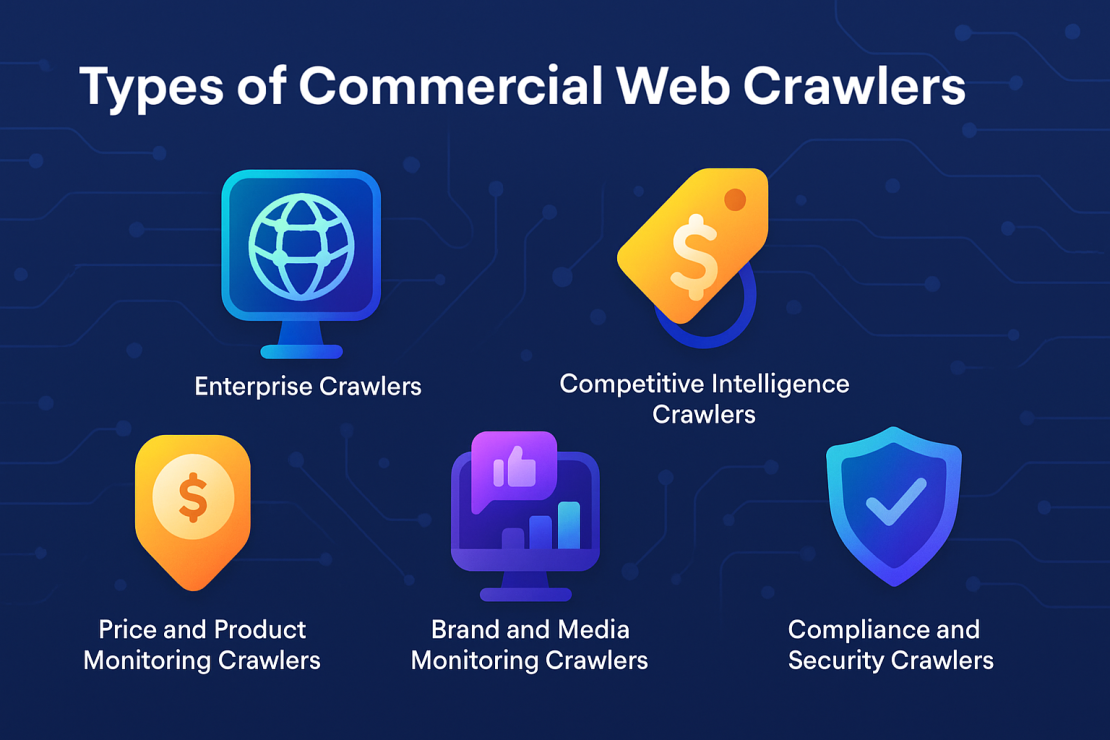
Enterprise Crawlers
Enterprise crawlers handle massive sets of pages and turn them into structured datasets. Systems like Common Crawl support this by scanning wide sections of the web. Research teams use them to study trends, map industries, or compare content across many domains. Some businesses use these crawlers to understand how entire markets shift over time. They make it possible to work with real data instead of snapshots that lose value fast.
Competitive Intelligence Crawlers
Competitive intelligence crawlers help teams follow changes in their industry. Diffbot-powered systems support this by extracting structured information from many websites. They help companies track product updates, pricing changes, and new content releases.
A retailer may use this type of crawler to follow competitor catalogs and spot new trends early. This gives them a clearer view of what others are doing and where they can gain an advantage.
Price and Product Monitoring Crawlers
Price and product monitoring crawlers support e-commerce businesses that need to stay aware of market changes. Many teams build their systems with Scrapy-based crawlers because they can scan product pages at scale.
These crawlers follow prices across hundreds of stores and report when something shifts. A company can use them to match prices, plan promotions, or adjust inventory in real time. So, if you want to stay competitive in oversaturated markets, this is your golden ticket.
Brand and Media Monitoring Crawlers
Brand and media monitoring crawlers help teams follow how their brand appears online. Systems like Meltwater and Talkwalker scan news sites, social platforms, and blogs. They gather mentions and track sentiment to show how people talk about a company or a topic.
As you can imagine, this is a goldmine for public relations, including brand coverage, reputation management, communication planning, and campaign reach.
Compliance and Security Crawlers
Compliance and security crawlers support companies that follow strict rules. They scan websites, documents, and internal systems to find outdated content or security issues.
These types of commercial web crawlers are invaluable for heavily regulated industries, such as finance and healthcare, among others. The generic corporate crawlers are usually tasked with ensuring that no document or page poses a security risk to the company.
Understanding how wide these commercial crawlers reach makes it easier to look at the tools that focus on your own site and its SEO needs.
Types of SEO Web Crawlers
SEO crawlers focus on your website and reveal how search engines read your pages. They work like diagnostic scanners that check each part of your site and highlight what slows your progress. Many people search for an SEO crawler list when they want a starting point, yet these tools do very different jobs. Knowing their roles makes your SEO work easier and far more effective.
Here are some of the most common SEO bots you may encounter:
- Googlebot
- AhrefsBot
- SemrushBot
- Moz’s crawler
- Screaming Frog
- Sitebulb
- Deepcrawl (Lumar)
Technical SEO Crawlers
Technical crawlers help you catch issues that hide deep inside your site. Screaming Frog can find broken links, redirect chains, or missing tags in minutes. These crawlers often reveal problems you notice only after rankings drop or pages slow down.
A typical example is a site that loses traffic because key pages link to outdated URLs. A quick crawl highlights these weak points so you can fix them before they cause more damage.
Indexing and Site Structure Crawlers
Indexing crawlers look at how search engines see your site. Deepcrawl, now known as Lumar, maps the structure of your pages and shows where search engines struggle. So, these tools reveal orphaned pages, blocked resources, or sitemap gaps that interrupt indexing.
Teams use them to understand how deep their pages sit in the site structure. This makes it easier to reshape navigation or remove obstacles that hide important content.
Performance-Focused Crawlers
Sitebulb is well known for its performance checks. It helps you see how slow pages affect user experience. It then shows why those pages struggle, whether it is large images, script delays, or heavy layouts.
Some businesses use this crawler to track slow product pages that harm conversions. A simple performance crawl can highlight problems that users feel long before teams notice them.
Content Auditing Crawlers
SemrushBot is often the first crawler that points to thin or duplicate content. It scans your pages and highlights text that fails to support rankings or user needs. AhrefsBot and Moz crawlers play a similar role by checking content depth and structure.
This type of crawler helps you shape a stronger content strategy. Of course, this makes your site more consistent and helps each page stay aligned with user intent.
Understanding these different crawler groups helps you see how each one supports your SEO work. Now that we can separate their roles, we can look at what they help you achieve.
Core Challenges and Considerations When Using Commercial and SEO Bots
Many beginners face the same problems when they start working with crawlers. These challenges appear whether you use commercial web crawlers or any bot from the SEO crawler list. A clear view of these common issues makes the next steps far easier to manage.
Choosing The Right Tools
Choosing the right tool often feels overwhelming. Many users start with a long SEO crawler list and struggle to decide which option fits their goals. You can make this easier by setting one clear target. Focus on a single goal such as fixing broken links, studying competitors, or checking performance. This narrows the list and keeps you from wasting time on features you don’t need at the moment.
Configuring Crawlers
Configuring crawlers is another common roadblock. A small error can limit the scan, block resources, or create gaps in the final report. In our experience, starting off small is the best way to avoid this issue. Run it on a few pages, check the results, then increase the scope. This simple step helps you spot blocked files or redirects before you launch a full scan.
Dealing With Enormous Data Sets
Handling the volume of exported data can feel just as challenging. Some commercial web crawlers produce huge datasets that demand deep analysis. You can make this process easier by breaking the report into smaller groups. Focus on one category at a time, such as broken links or metadata. This turns an overwhelming task into a series of simple steps.
Prioritizing Reports
Reading and prioritizing reports is usually the biggest problem beginner users face. SEO bots highlight issues across structure, content, and performance. What we usually do is sort the problems into three groups. Firstly, we fix anything that blocks indexing. Then we move to sorting out the broken links. Finally, we review content and performance. This way, we keep our attention on a single issue, rather than going all over the place.
Tech Limitations
Finally, there are the tech limits. Slow servers, blocked scripts, or restricted access often cause crawlers to time out. You can reduce these issues by checking your robots.txt file and enabling access to essential resources. Most importantly, however, run your crawls during low-traffic hours. You don’t want your crawlers to compete with your regular visitors for server resources. These small fixes help crawlers complete their work without interruptions.
Seeing these challenges from both sides helps you treat crawlers as tools, not obstacles. With a clear plan and a steady process, they become easier to manage and far more useful. This sets the stage for the next step, which is knowing when to use each crawler in a way that supports your wider SEO goals.
When to Use Commercial Web Crawlers in Your SEO Strategy
Timing plays a major role in how effective your crawling work becomes. Many people search for an SEO crawler list before they know when to run these tools. Commercial web crawlers can support important decisions, yet their value depends on when you trigger them. The right moment turns raw data into guidance that fits your goals.
So, when should you use these helpful bots?

Before Major Site Changes
Large updates benefit from a clear map of your current site. Crawls before a redesign or navigation update reveal depth, structure, and weak areas that need attention. These early scans help you avoid broken paths or missing links during the transition.
A small business preparing a new layout often uses a crawl to confirm which pages deserve better placement. This saves time and reduces mistakes once the new version goes live.
After Significant Updates
Some changes create hidden issues that only appear during crawling. A migration can leave redirect chains, blocked files, or missing metadata. Crawls after major updates highlight these problems before they impact rankings.
Teams often scan their site immediately after launching new templates. This confirms that all resources load correctly and that no pages fall out of the structure.
When Performance Drops
A sudden ranking drop or a shift in traffic often signals deeper problems. Crawlers help you see whether slow pages, blocked scripts, or missing assets cause the decline. These insights help you focus on issues that affect users and search engines.
Some site owners run crawls after they notice delays on key pages. This quick check reveals what changed and where fixes will have the greatest impact.
Before Starting a Backlink Campaign
Strong backlinks work best when your pages are easy to crawl. SEO bots help you review internal links, content gaps, and thin pages that weaken your strategy. They also reveal problems that harm your backlink campaigns by hiding important content.
A quick crawl before outreach helps you confirm that your structure supports a strong backlink portfolio. This improves the quality of the results you gain from every link you earn.
When Expanding Into New Markets
Market expansion brings new competitors and new content trends. Commercial web crawlers help you understand what local players publish and how they engage their audience. A scan across regional sites reveals patterns that guide your next steps.
A company entering a new region often starts with a broad crawl to study local tone and structure. This helps them shape content that fits the expectations of their new audience.
During Regular SEO Health Checks
Frequent light crawls prevent small issues from becoming major problems. They reveal broken links, missing tags, and performance changes that appear over time. These checks work best when run monthly or quarterly.
Some teams keep a schedule to stay ahead of problems. This helps them act before issues grow and keeps their site aligned with search engine expectations.
Using crawlers when the timing is right lets you gain more value from every insight. With the use cases clear, it is time to look at how your hosting environment supports or limits that process.
How to Choose the Right Crawlers for Every SEO Goal
Choosing the right crawler depends on what you need to learn at a given moment.
SEO crawlers should be your priority when the goal is improving visibility, fixing technical issues, and ensuring search engines can properly crawl and index your site. They shine when you need fast, actionable insights into broken links, page performance, metadata, and structural problems that directly affect rankings.
Commercial crawlers, on the other hand, tend to deliver a higher return on investment when broader data is required. They are most valuable for competitor research, market analysis, content benchmarking, and tracking trends across large groups of websites. When decisions extend beyond your own domain and into strategy, positioning, or expansion, commercial crawlers provide context that SEO bots alone cannot offer.
Using both together creates a more complete picture and helps you avoid blind spots. SEO crawlers show how search engines experience your site, while commercial crawlers reveal how your site fits into the wider web ecosystem. Combined, they support smarter decisions, reduce guesswork, and ensure your optimization efforts are guided by both internal performance and external reality.
How Hosting Affects the Performance of Commercial Web Crawlers
Crawlers rely on a stable environment to do their job well. Even the best scanning tools slow down or fail when the server responds late, blocks important files, or struggles under load. Solid hosting gives crawlers the clean path they need to reach your pages and read them without interruptions.
Fast loading speeds help crawlers move through your site without delays. A stable server ensures they can access scripts, styles, and images without timing out. Secure configuration keeps their requests safe and prevents false warnings. These small gains build up and help both commercial crawlers and SEO bots work with accurate information.
This is where HostArmada can provide a practical advantage. Our platform is designed to remove the obstacles that slow or break crawler activity. Lightning-fast speed helps every request move smoothly. Top-of-the-line security protects your data without blocking legitimate visitors or bots. The 99.9% uptime guarantee keeps your site accessible, even when traffic grows.
These strengths also make crawler control easier. If you want to fine-tune how crawlers reach your site, the clean foundation gives you full confidence that your settings work as intended. You can explore better ways to guide these tools through your pages with our guide on web crawler management.
Performance, stability, and security shape how crawlers understand your content. If you want your site to stay fast, safe, and always available for both users and bots, check out our hosting plans and give your website the strong foundation it deserves.
FAQs
SEO crawlers analyze your own website to identify issues that affect search rankings, such as broken links, indexing problems, and performance bottlenecks. Commercial web crawlers collect data across many websites for research, monitoring, and market analysis.
Use an SEO crawler when you want to improve technical SEO, fix site errors, or understand how search engines view your pages. They are best for ongoing site health checks and ranking optimization.
Yes, using both together avoids blind spots. SEO crawlers reveal internal issues, while commercial crawlers provide external context, allowing for more informed and balanced decisions.
Crawlers can impact performance if misconfigured or run during peak traffic. Limiting crawl speed, scheduling scans during low-traffic hours, and proper server configuration help prevent issues.
