

Technology / Monday March 2, 2026
Does It Matter Which Web Browser You Use?

When we think of the internet, it’s hard to imagine it without a web browser. In essence, a web browser lets you access any website online. It establishes the connection between you and the host server and delivers all the information that the website owner intended you to see. While that’s the web browser’s primary function, there are nuances across different web browsers.
But does it really matter which browser you will use? The short answer is a resounding yes. The long one is a bit… well, longer. So, if you want to learn why it matters, what the differences between the browsers are, what other people are using, and what you should use, buckle up, and let’s find out.
What Do Web Browsers Do?
If you are reading this, you are on a web browser. Whether it is Chrome, Firefox, Safari, Edge, Opera, or something else, you are using a browser to visit our website. Thank you for being here, by the way. In fact, each website you’ve ever visited uses a web browser. We are strictly talking about websites, though, as you can listen to music via Spotify and watch movies via Netflix by using their platforms. This means you are still using the internet, but you are not entering a website; instead, you are using an app.
Of course, the primary function of each web browser is to fetch the website from the hosting server and display it on your monitor. You can check how that happens in our dedicated article on DNS and the eight steps of opening a website. In a nutshell, the browser queries the Recursive Nameserver to locate the IP address for the domain you requested. Thus, you don’t have to memorize complicated number sequences, but easily memorable names, like HostArmada.com, for example. The translation of the address is actually done by the DNS, however, not the browser. The browser only sends the domain name to the DNS.
Then There Is Opening the Website
Still, retrieving the website is only part of what the browser does. Don’t imagine the website being received as you see it on the browser. What the browser receives is a package of files, including HTML, CSS, and JavaScript. So, the browser has to interpret the HTML code and lay out the page’s structure on your screen. Then, it implements the CSS code. This will add the styles, fonts, and colors for the different elements. Finally, the browser will read the JavaScript. This will add the interactive elements and dynamics of the content. Imagine a carousel rotating with different images.
All of this should be a sign that the shorter, cleaner, and better-arranged your website code is, the faster the browser will load it. So, make sure to keep your code as clean as possible so that, no matter what browser your audience is using, they won’t have any trouble loading it as fast as your hosting provider allows.
Other Functions
In addition to those core functions, web browsers have a plethora of other useful functions that aim to improve your experience. Saving websites as bookmarks, using multiple tabs, and adding various extensions with all sorts of functionalities, and, of course, security features are the bare minimum today. However, there are some differences in the usability of these functions.
Are There Differences in How Web Browsers Operate?
Yes. Though the primary and secondary functions are largely the same, they differ in their operation. This is predominantly due to the different rendering engines they use. For example, Chrome, Edge, and Opera use Blink, while Firefox utilizes Gecko. Apple, which is trying to keep its environment clean from third-party software developers, as this often leads to security issues, developed WebKit. Naturally, Safari uses it.
A rendering engine is a web browser’s core component that interprets HTML, CSS, and JavaScript and displays web pages on the screen. In essence, this is the heart and soul of the browser.
Each of these rendering engines has its pros and cons. For example, Gecko is an open-source product of Mozilla, and thus it offers incredible compatibility features. It’s often at the forefront of user experience development, and the support is predominantly outstanding. However, due to its open-source nature, security is lagging behind its competitors.
WebKit is, without a doubt, the big dog in this group when it comes to security. Just like every other Apple product, WebKit is like Fort Knox. However, due to Apple’s insistence on having a closed environment, its compatibility is lagging behind, as is its stability with some websites.
Blink, on the other hand, has astonishing speed, especially since Google developed it. The compatibility, stability, and other measurables are off the charts. However, Blink needs a moderately powerful machine to operate, using more CPU, memory, and disk space to render web pages. This makes it particularly heavy for older machines, and thus, in some cases, when you open too many tabs simultaneously, your browser may freeze.
So, choosing your browser depends entirely on what you are ready to sacrifice.
What Do Other People Use?
While you are wondering about your priorities, let’s have a look at what other people decide for themselves. Well, just like with their choice of search engine, people worldwide prefer Google’s product. About 65% of all internet users have Chrome as their web browser of choice. Unsurprisingly, next is Safari, at 18.5%, which roughly corresponds to Mac and iOS users. Edge takes third place, just short of 5% of users, followed by Firefox and Opera at 3.4% and 2.9%, respectively.
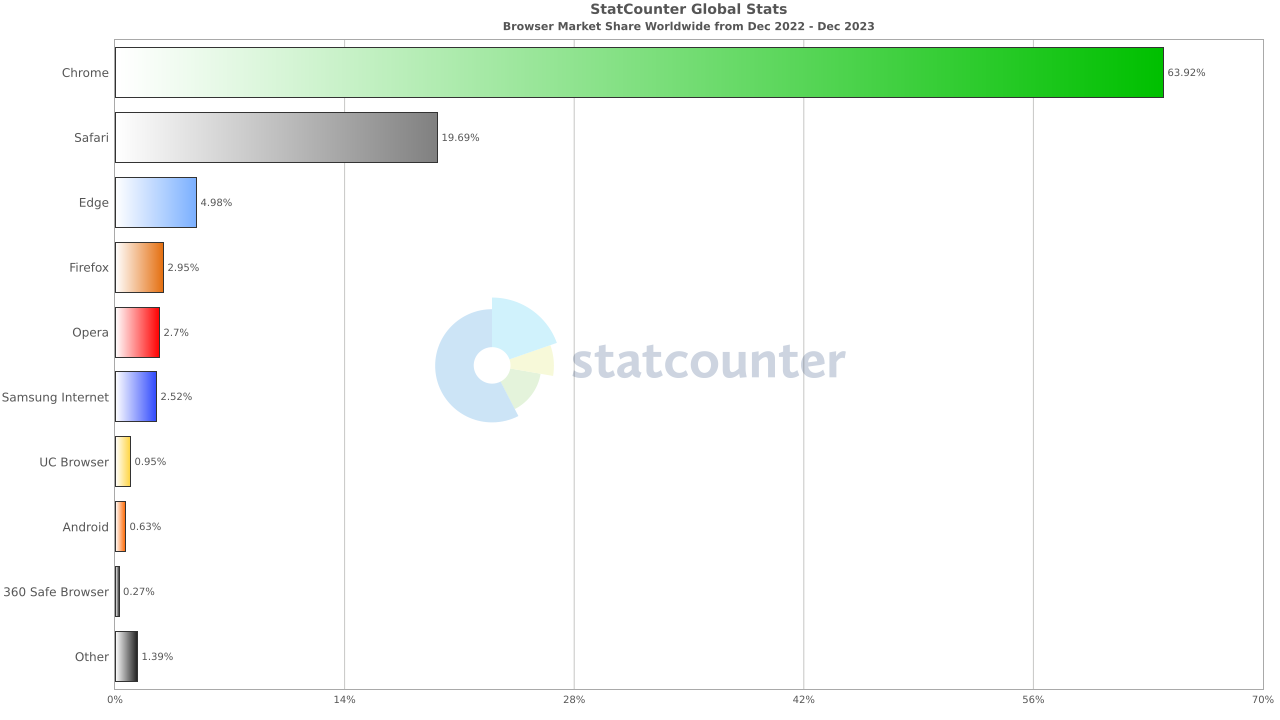
However, the results are a bit more balanced in the United States alone. Still, Chrome holds the lion’s share of the market, with about 49.8% of users preferring it. Safari is once again second, with 31.15% of internet users; Edge almost doubles its share to 8.35%, as does Firefox at 4.78%. Opera loses the confidence of US internet users and attracts only 2.8% of all users.
It’s evident that Google’s product dominates worldwide. There isn’t a single country where Chrome is not the most preferred browser. But why do people prefer it over the more secure Safari or the more lightweight Firefox? Why isn’t Microsoft’s default Edge disregarded in favor of Chrome? Let’s have a more in-depth look at the best browsers one by one.
Chrome
Chrome is by far the most widely used browser in the world. Owning roughly two-thirds of the entire market is formidable indeed. But Chrome is not the most preferred simply because Google recommends it. True, that has its weight, but the fact is that Chrome has an exceptional design that focuses on user experience. But that’s just the tip of the iceberg.
Pros
- High-speed browser – As we’ve often discussed, today’s internet user doesn’t have 30 minutes to open a single picture as we did in the 1990s. No, today, speed is everything. And when it comes to speed, no one is better than Chrome. This is essential when streaming or watching videos. Google’s browser reduces lag and loads websites faster due to its programming.
- Gorgeous design – Yes, having a good-looking design is not everything, but come on. No one wants to surf in something that’s a flash from the dawn of the internet. Chrome’s design is predominantly driven by user experience. Most users find it quite effortless to navigate. All menu tabs are tucked away in the settings, which lie unobtrusively in the top-right corner. And best of all, there is only one search bar, which doubles as both an address bar and a search bar. This helps immensely if you make a mistake typing the address, as Chrome won’t show you the dreaded 404 page or something similar, but will redirect you to Google, where you will find precisely what you are looking for.
- Safety – Chrome offers a range of safety features that help ensure your browsing won’t expose your computer to unnecessary risks. The browser will show you if the website has an SSL certificate. Furthermore, it will protect you from downloading malware on your computer and cleaning up suspected malicious files.
- Sync across devices – If you work on multiple devices, you can sync your Chrome and work from any device without interruptions or having to open the same set of tabs.
- Extensions – The extensions are probably the best part of Chrome. This browser has an entire library of cool features you can add if you want to. Blocking ads, checking grammar, anything really. The library has hundreds, if not thousands, of extensions at your disposal to enhance your user experience.
Of course, despite Chrome’s superiority in many areas, it still has some work to do in some areas.
Cons
- Questionable user privacy – This is the big one that deters many from joining the rest of the world in using Chrome. Actually, Google has been sanctioned multiple times in Europe for collecting and using users’ data without their consent. How else do you think Google gathers enough information on what people like or dislike, how long they stay on your website, or what pathways they take to get there? Yes, if you value your privacy above all, Chrome is probably not the best choice.
- Heavy resource user – The other downside is that Chrome is an extremely heavy user of CPU and RAM. This matters little if you only use Chrome. But if multiple applications are open and your machine is not that powerful, Chrome will consume all available memory, and all your other applications will either lag or freeze.
Safari
Next on everyone’s list, including ours, is Safari. Safari is a great browser if you are an Apple lover, and not so much if you have any other device that you want to use. Still, this browser confidently takes about a fifth of all internet users, so let’s have a look at why.
Pros
- Extremely efficient – This is hands down the most efficient web browser out there, with lower resource consumption than any other on our list. The developers at Apple have created this browser with their hardware in mind, so it operates as part of the ever-growing Apple digital ecosystem.
- Top-level security – Being part of the Apple digital environment, it’s safe to say that this browser’s security is unmatched. Apple prides itself on personal data protection and its tough security. No wonder even the US president uses their products. Now, whether he uses Safari per se is hard to tell, but it’s clear that Apple products and security go hand in hand.
- Secured privacy while browsing – When it comes to security, that includes protecting each user’s privacy. Safari uses a built-in privacy tool that prevents web trackers. Moreover, the browser uses a Privacy Report tool that prevents cross-website tracking without affecting the website’s functionality. This allows you to surf without wondering who’s watching your every move.
- Supreme usability – As part of the Apple universe, Safari is seamless to use if you are used to Apple’s OSs. It is familiar, easily navigable, and beautifully minimalistic.
Let’s not forget, however, that Apple products don’t play particularly well with others.
Cons
- Not working with other OSs – As usual, integration with other OS was not at the top of Apple’s mind when they created Safari. Thus, Android or Windows users can’t use the browser, which is a shame.
- Limited extension availability – That’s the other thing. As Apple rarely trusts third-party developers, Safari’s extension library is more like a small bookcase. In this regard, it can’t compare with the rest of our entries.
Edge
Edge is the default web browser for most Microsoft OS users. Still, Edge is mainly used as a tool to download Chrome and be done with it. However, especially in the US, there is a massive number of users who actually prefer Edge over any other browser. That’s not surprising, given how long this browser has been around since its inception.
Pros
- Highly customizable – Edge is probably the most customizable browser of them all, as it offers a lot of options to make the browser your own. The home page lets you receive news, get quick access to products, or view the current stock market or weather. It also gives you quick access to games, music, video, traffic information, and more.
- Tracking prevention – Edge lets you decide how much you want to be tracked online. It offers you three levels of tracking prevention, each restricting a different group of trackers that follow your every move.
- Massive library of extensions – As Edge uses Chromium as a base, it can implement all Chromium-based extensions, making its library just as big as Chrome’s. However, Microsoft has developed some additional add-ons that can be used only with Edge. These include some great software, such as 360 View, OneNote, and Web Clipper.
- Extremely lightweight – Though Edge requires at least 1 GB RAM for 32-bit Windows and 2 GB for 64-bit Windows, its usage is significantly lower. In fact, Edge is the best performer in this regard.
Cons
- Speed is not its thing – Unfortunately, the lower consumption translates into much lower speed. Chrome, Firefox, and Safari have much better performance, which probably pushes most users to disregard this otherwise great browser.
- Poor reputation – The other big problem is Edge’s reputation. As the successor to Internet Explorer, it has many drawbacks in users’ eyes. And although Microsoft is investing heavily in changing this reputation, there is a long way to go until people stop making fun of Edge.
Firefox
Firefox is often the choice of those who refuse to bow down to Google and place a high value on their privacy. Plus, Firefox does have some pretty sweet advantages over its competitors.
Pros
- Privacy on a new level – Privacy is Mozilla’s unique sales proposition. While other browsers would want you to confirm that you don’t want your data stolen, Firefox takes privacy to a new level. The browser will block any spyware or malware that tries to download in the background while searching at an unsafe website. Furthermore, it will automatically limit third-party tracking abilities.
- Outstanding speed – When it comes to speed, Firefox is on par with Chrome. It is considered even better for download speed.
- Great extension library – Firefox is the master of extensions. Arguably, it has the most extensive library of extensions among all the browsers. Thus, you can literally find anything you need in their library. Naturally, user experience and customization are also top-notch.
- Minimalistic interface – The design is beautiful, especially with the stylish logo front and center. The homepage is extremely minimal, allowing you to focus on where you’re going rather than the browser itself.
Naturally, there are some downsides to Mozilla Firefox. Otherwise, why would it be the fourth most preferred browser?
Cons
- Compatibility issues – That’s actually the biggest problem with Firefox. Some web developers disregard Firefox’s unique needs, and some websites do not show as intended on this browser. This leads to loss of functionality and overall user dissatisfaction. Some website owners even suggest that users use a different browser so they can experience the website as intended. This is indeed a hard blow against Firefox.
- Huge RAM consumer – Just like Chrome, Mozilla is a heavy RAM user, and you need a sturdy machine if you want to use the limitless tab options that Firefox offers.
Opera
Opera is the most popular alternative to mainstream browsers. Furthermore, it is one of the oldest, as the first version of Opera dates back to 1994. Although it has used the Chromium codebase since 2013, Opera remains a unique choice for internet browsing.
Pros
- Usability on a new level – Opera is truly unique in its approach to usability. While most browsers strive to be as minimalist as possible, Opera stands as a beacon of an all-in-one usability paradise. For example, they offer a built-in messenger application that allows you to receive messages from FB, IG, WhatsApp, Telegram, and VKontakte directly in the sidebar.
- Turbo and Battery Saver mode – Opera offers two unique modes to improve the user experience. Turbo Mode allows users with slower internet to increase their connection speed. Unfortunately, they don’t work with encrypted websites, which makes it a bit useless nowadays. On the other hand, the Battery Saver mode is a goldmine for those who have time to spare and want to keep their battery alive longer.
- Built-in privacy feature – Opera is a great choice for users who prefer to stay anonymous. The browser offers an array of built-in privacy features, such as a tracker blocker, an ad blocker, a cookie blocker, and more.
- Integrated VPN – To top it all off, Opera offers a free built-in VPN that provides additional privacy protection for its users. See why PrivacyJournal recommends these best VPN services.
Cons:
- Slower than its main competitors – The biggest problem with Opera is its speed. It simply can’t compare to other browsers on this list. Still, that doesn’t mean a website takes ages to load, but the time difference is notable.
- Bugs and breakdowns – Furthermore, users often experience bugs and breakdowns, which can be pretty frustrating. Despite the excellent support, this problem is a considerable drawback.
- Not a high priority among web developers – Another significant downside is that developers often forget to test their websites on Opera. Thus, some websites appear broken when opened on this browser.
Which One Should You Use?
So, now that you have the pros and cons of the most popular web browsers, you can choose your priorities. Chrome is, without a doubt, the best choice if you have various devices, not all of which use IOS or macOS. However, with Chrome, you compromise on your privacy. On the other hand, if you are an Apple fan, Safari is the safest bet, as it is built precisely for you.
Firefox is an excellent choice for those who seek the Chrome experience, yet with far fewer privacy intrusions. At the same time, Edge is for those who prefer a highly customized home page that lets them access the most important information without ever clicking.
Finally, Opera is the odd choice for those who want to be outside the mainstream and experience a new kind of user experience.
What you will choose when browsing the internet depends entirely on you.
On the other hand, as a website owner, you must optimize your website for every browser. Even though Opera has only 2.9% market share, it still represents several million people who may be interested in your products. So make sure to accommodate all of them. And yes, these browsers may be a bit sluggish, but if you have top-of-the-line hosting with lightning-fast load times guaranteed, the micro delays in Opera and Edge will not hinder your success.
HostArmada offers precisely this – fast, secure, and reliable hosting for your website. On top of lightning-fast speed, we offer robust security features and guarantee 99.9% uptime.
So, if you are a web developer, check out our offers and make your business twice as reliable.
FAQs
Yes. Different browsers collect and manage user data in different ways. Browsers like Firefox and Safari prioritize built-in tracking prevention, while others may collect more usage data for personalization and advertising purposes.
In some cases, yes. Browsers use different rendering engines and resource management systems, which can impact page load speed, responsiveness, and memory usage, especially on older or lower-powered devices.
Most modern websites are optimized for all major browsers, but small differences in rendering engines can sometimes cause layout or functionality issues. This is why developers test websites across Chrome, Safari, Edge, and Firefox to ensure consistent performance.
