

Human Resources / Thursday September 3, 2026
Freelance vs. Agency vs. In-House WordPress Developers: Which Should You Choose?
Choosing between a freelance, agency, or in-house WordPress developer depends on your budget, project complexity, and long-term business needs. Freelancers are typically the most affordable option for one-off projects and smaller websites, agencies provide access to specialized teams for larger or more complex work, while in-house developers are best for businesses that need continuous website development and maintenance.
This is why the comparison between freelance vs. agency developer setups matters before you even start looking to hire web developer support. Each option comes with its own way of handling responsibility, communication, and long-term maintenance. Understanding those differences early prevents problems that no level of technical skill can fix later.
So, to help you out, we broke down the key differences that really matter between freelance, agency, and in-house developers.
Freelance vs. Agency vs. In-House WordPress Developers: Key Differences
The fastest way to understand the difference between these options is to look at how they operate in practice. When comparing freelance vs. agency developer setups alongside in-house roles, the real distinctions come down to communication, capacity, and long-term reliability. This overview highlights how each model works without yet deciding which one is right.
| Factor | Freelance Developer | Agency | In-House Developer |
| Typical Setup | One individual handling tasks directly | Team with defined roles and processes | Full-time employee inside your business |
| Communication Flow | Direct and fast, but depends on availability | Structured, often through account or project managers | Immediate and internal |
| Speed of Execution | Fast for focused tasks, slower for complex work | Slower to start, faster once the process is in place | Consistent, depends on internal priorities |
| Capacity & Coverage | Limited to one person’s bandwidth | Scalable across multiple specialists | Limited to one hire unless the team grows |
| Flexibility | High for small changes and quick tasks | Moderate, changes follow a defined process | High within internal priorities |
| Continuity & Reliability | Depends on individual availability | Strong due to team structure | Strong as long as the role remains filled |
| Cost Structure | Pay per task or hourly, flexible | Higher cost, bundled services | Fixed salary plus overhead |
| Best Use Case | Small to mid tasks, one-off projects | Larger projects, ongoing development | Continuous development, long-term ownership |
| Main Risk | Dependency on one person | Slower communication and higher cost | Underutilization if workload is low |
Freelance WordPress Developers
A small update turns into a quick message. A bug gets fixed the same day. A landing page goes live without waiting for approvals or process layers. This is how working with a freelance WordPress developer usually feels when the scope is clear and the work is focused. You communicate directly with the person doing the work, which keeps things fast and flexible.
That speed comes from simplicity. There are no handoffs, no internal coordination, and no dependency on a wider team. At the same time, that simplicity is also where the model starts to show its limits once the workload grows or becomes more complex.
Strengths
- Direct communication. You work with the person doing the task, which removes delays and misinterpretations.
- Fast turnaround for focused work. Small to mid-sized tasks can often be completed quickly without process overhead.
- High flexibility. Changes and adjustments are easier to make without going through structured workflows.
- Cost efficiency for a limited scope. You pay only for the work you need, which keeps costs predictable for smaller projects.
Limitations
- Limited capacity. One person can only handle a certain amount of work at a time.
- Dependency on a single individual. If they become unavailable, your project may stall completely.
- Narrower skill coverage. Complex projects may require skills outside one person’s expertise.
- Inconsistent long-term availability. Freelancers often juggle multiple clients, which can affect continuity.
Best For
- Small to mid-sized websites. When the scope is defined and doesn’t require multiple roles.
- One-off tasks or fixes. Ideal for updates, bug fixes, or isolated improvements.
- Projects with clear boundaries. Work that doesn’t require ongoing coordination or scaling.
- Businesses with limited development needs. When work appears occasionally rather than continuously.
WordPress Agencies
Agencies solve a different kind of problem. When a project requires multiple skills, tighter coordination, and predictable delivery, a single person is rarely enough. Agencies bring structure into the process, with defined roles, workflows, and testing layers that reduce risk. This is where practices like website staging become part of the process, allowing teams to test changes before they go live rather than react after something breaks.
That structure makes agencies more reliable for complex work. At the same time, it introduces a different kind of friction. Communication moves through layers, changes follow a process, and speed depends on how the system is set up rather than how quickly one person can respond.
Strengths
- Access to multiple specialists. Projects benefit from developers, designers, and other roles working together.
- Higher reliability and continuity. Work does not depend on one individual’s availability.
- Structured workflows. Tasks move through defined processes, reducing the chance of errors.
- Scalability. Agencies can handle larger or evolving projects without needing to rebuild the team.
Limitations
- Slower communication cycles. Messages often pass through account or project managers before reaching the developer.
- Process overhead. Even small changes may need to follow internal workflows.
- Higher cost structure. You pay for the team, not just the task.
- Less direct control. You are working with a system, not a single point of contact.
Best For
- Larger or more complex websites. Projects that require multiple roles and coordination.
- Ongoing development and support. When work needs to continue over time with consistency.
- Businesses that need reliability over speed. Where stability matters more than immediate response.
- Projects with broader scope. Work that includes design, development, and long-term improvements.
In-House WordPress Developers
In-house developers usually appear when the website stops being a project and becomes part of daily operations. At that point, the need is no longer occasional fixes or structured delivery. It becomes continuous development, ongoing maintenance, and full alignment with business priorities. This is where practices like working with a WordPress child theme become standard, allowing changes to be controlled, tracked, and maintained over time without breaking the core system.
That level of control is the biggest advantage of an in-house setup. The developer understands the product, the internal processes, and the long-term direction. At the same time, this model only works when there is enough consistent work to justify it. Without that, it quickly becomes inefficient.

Strengths
- Full alignment with business goals. The developer works within your priorities, not across multiple clients.
- High continuity and ownership. Knowledge stays inside the company and builds over time.
- Immediate communication. No delays, no intermediaries, direct collaboration with internal teams.
- Better long-term consistency. Decisions follow a unified direction instead of changing across projects.
Limitations
- High fixed cost. Salary, tools, and overhead make this the most expensive model.
- Limited capacity per person. One developer can only cover so much work at once.
- Narrower exposure. In-house developers may lack the breadth of experience agencies gain across multiple projects.
- Harder to scale quickly. Expanding capacity requires hiring, not just assigning more resources.
Best For
- Websites that require constant development. When updates, improvements, and changes happen regularly.
- Businesses heavily dependent on their website. Where the site is a core part of operations, not just a presence.
- Long-term product development. Projects that evolve continuously rather than in isolated phases.
- Teams that need tight internal collaboration. When marketing, sales, and development must stay closely aligned.
How to Choose Between a Freelance, Agency, or In-House Developer?
When we approach decisions like this, we don’t start with the type of developer. We start with the work itself. The right choice becomes obvious once you look at how often the work appears, how complex it is, and how critical it is to your business.
Here’s a simple way to break it down.
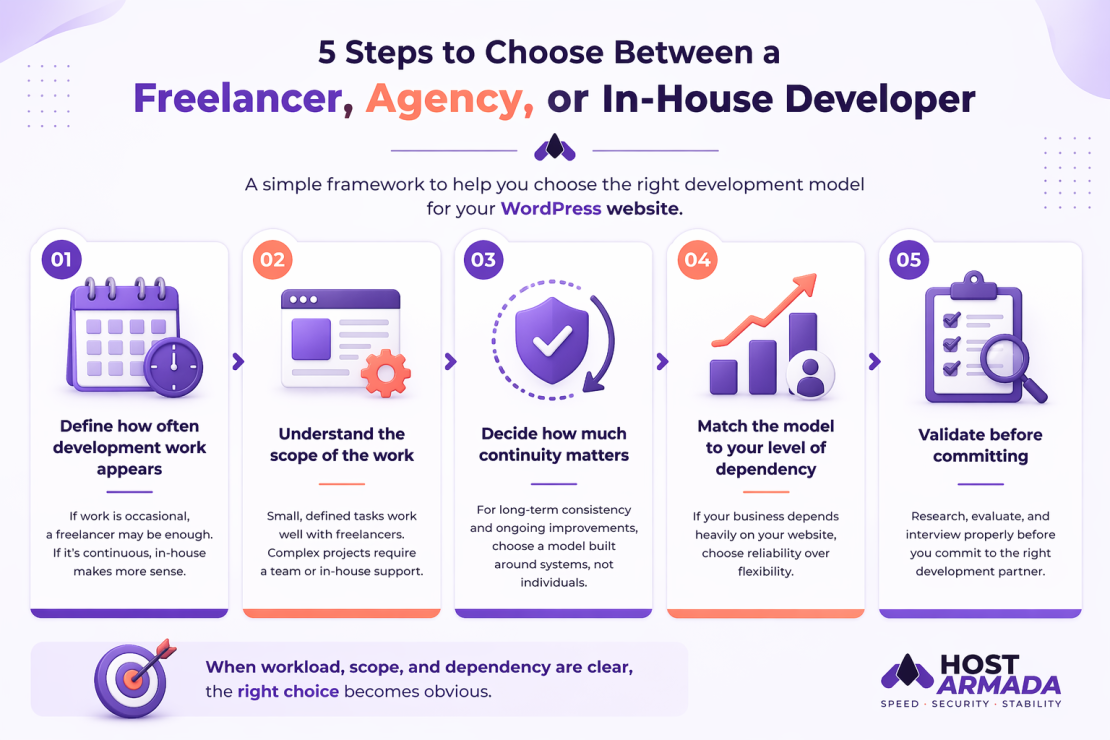
1. Define How Often Development Work Appears
If work shows up occasionally, a freelance WordPress developer is usually enough. However, if it comes in waves or requires coordination, an agency becomes more practical. If it never really stops, in-house starts to make sense.
Frequency is the first filter. It tells you whether you need flexibility, structure, or full-time ownership. The same capacity considerations apply to digital marketing. Businesses that experience fluctuating workloads or want to introduce new services without committing to additional full-time hires can consider a White Label Digital Agency like Mavlers Agency. A specialized partner can provide additional execution capacity while the business retains ownership of the client relationship and overall strategy.
2. Understand the Scope of the Work
Small, clearly defined tasks work well with freelancers. Broader projects that include multiple moving parts require a team. Continuous product development demands internal control.
At this stage, knowing the required WordPress Developer Skills becomes important because complexity often depends on the type of expertise needed.
3. Decide How Much Continuity Matters
If your website needs long-term consistency, documentation, and ongoing improvements, relying on a single external resource may create risk. On the other hand, agencies and in-house developers handle continuity better because they are built around systems, not individuals.
This is where many hiring mistakes begin. So, the model is chosen for short-term convenience instead of long-term fit.
4. Match the Model to Your Level of Dependency
If your business depends heavily on your website, delays and gaps become costly. In that case, reliability matters more than flexibility. If the website plays a smaller role, flexibility often wins.
Once you reach this point, the next step is not just deciding on the model, but moving forward to actually hire WordPress developer support in a way that fits your needs.
5. Validate before committing
Choosing the right model is only half the decision. The execution still matters. That includes where you look, how you evaluate candidates, and how you confirm they can deliver.
This is where:
- Developer hiring sites become relevant.
- Knowing how to interview web developer candidates properly makes a difference.
A good decision here doesn’t feel complicated. Once the workload, scope, and dependency are clear, the right option tends to stand out.
Common Mistakes When Choosing a WordPress Developer Type
In many cases, the wrong choice doesn’t come from a lack of options. It comes from focusing on the wrong criteria. These decisions often look reasonable at the start, but they create friction as soon as the work begins.
Here are the most common issues to avoid.
- Choosing based on price alone. Lower cost can look attractive, but it often ignores how much work will be needed over time and how the model handles it.
- Expecting a freelancer to operate like an agency. One person cannot provide the same coverage, speed, and coordination as a team.
- Assuming agencies guarantee better results. Structure improves reliability, but it does not replace clear communication or proper alignment.
- Hiring in-house too early. Without a consistent workload, this becomes a high-cost solution with limited return.
- Ignoring long-term continuity. Decisions made for short-term convenience often create long-term dependency risks.
- Choosing a model you don’t have the capacity to support. Some setups require internal coordination and oversight. If you don’t have the time or structure to manage developers, even a strong hire can underperform.
- Confusing availability with commitment. Fast responses do not always mean long-term reliability or ownership.
These are closely related to broader hiring mistakes, but here they are specific to choosing the wrong model rather than the wrong person.
Even the Right Developer Fails in the Wrong Environment
Choosing the right developer solves only part of the problem. The rest depends on the environment they work in. A skilled developer can still run into delays, performance issues, or unexpected limitations if the hosting setup does not support the work properly. At that point, the issue is no longer about the person or the model. It becomes a technical constraint.
This is where things like using the right configuration, maintaining stable performance, and applying the best PHP version for WordPress practices start to matter. The same applies to protection. Without strong WordPress website security, even well-built solutions remain exposed to risks that sit outside the developer’s control.
At this stage, the focus shifts from fixing problems to preventing them. This is where the hosting environment becomes part of the workflow. A platform like HostArmada provides the stability, performance, and security foundation that allows developers to work without unnecessary limitations. Instead of compensating for slow response times, resource instability, or weak protection, the work can remain focused on building and improving the site.
If your website plays an important role in your business, the setup behind it needs to support that role. Exploring reliable hosting plans becomes the next logical step once the right development model is in place.
FAQs
A freelance WordPress developer is usually better for smaller projects, limited budgets, and occasional work, while a WordPress agency is a better choice for complex websites, ongoing support, and projects requiring multiple specialists.
Hiring an in-house WordPress developer makes sense if your business relies heavily on its website and requires continuous development, maintenance, security updates, and close collaboration with other teams.
Yes. Freelance WordPress developers generally have lower overhead costs than agencies or full-time employees, making them the most cost-effective option for one-time projects and small businesses.
Consider your project scope, budget, expected workload, long-term maintenance needs, required expertise, and how much ongoing communication and support your business will require.
