

Development / Saturday January 17, 2026
Scripting vs. Programming Languages: Understanding the Real Difference
The line between scripting vs. programming languages often feels thinner than it really is. People use the two interchangeably all the time in day-to-day work. A short script and a full application both rely on code, both automate behavior, and both can solve real problems. That surface similarity makes the distinction easy to ignore.
The confusion starts causing trouble when conversations move beyond casual internal chatter and tasks begin to depend on precise meaning. Once you involve real-life outcomes planning, ownership, and expectations all shift. Treating these terms as interchangeable at that stage can lead to delays in the roadmap, misunderstandings across teams, and time spent building something that never fits its intended role.
A common example appears during project planning. One team expects a quick, flexible solution that can change as requirements evolve. Another assumes a structured system meant to scale and remain stable over time. Both sides say they want a “simple script” or a “small program,” but mean very different things by it. The result is friction, rework, and frustration that have little to do with code quality and everything to do with mismatched assumptions.
Clarifying the difference between scripting and programming helps prevent those breakdowns. Once you understand the underlying approach, aligning decisions on structure, execution, and expectations becomes easier. That clarity removes guesswork early, long before misunderstandings turn into wasted effort.
How People Understand “Scripting” and “Programming”
In day-to-day conversations, the words scripting and programming rarely describe how code actually runs. Instead, they act as shorthand for intent, scope, and perceived effort. Teams use them to signal expectations quickly, even when those expectations are not technically precise.
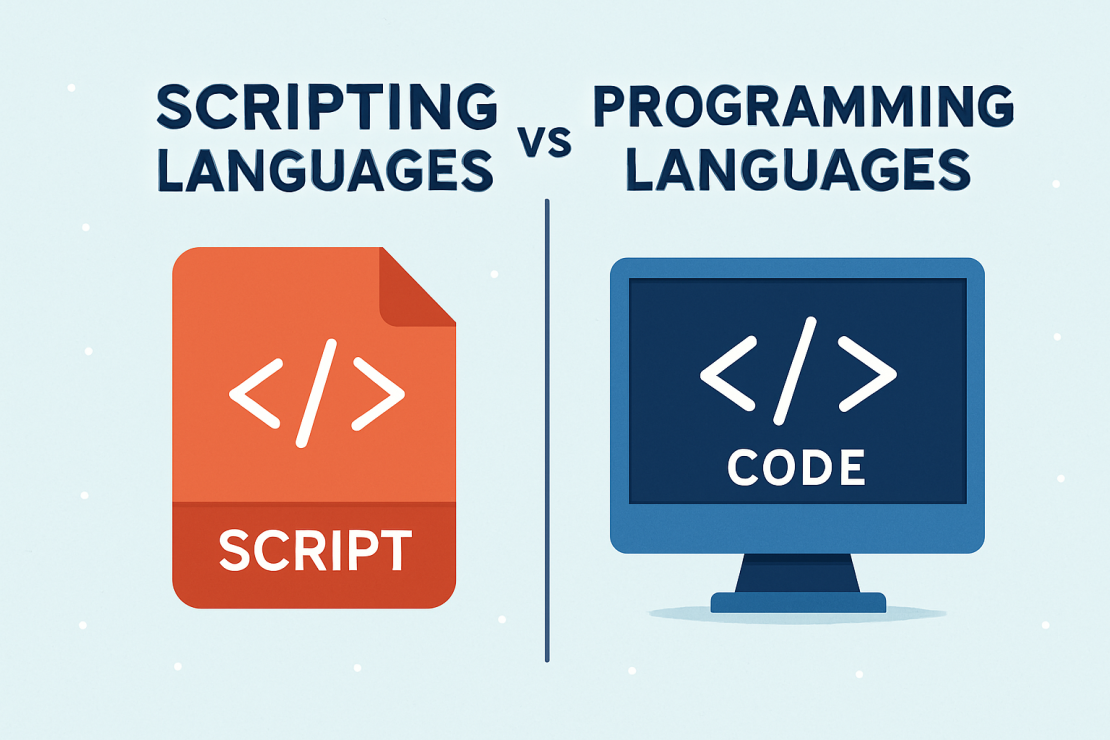
Over time, this shorthand has become entrenched in informal assumptions. Users often associate scripting languages with speed and flexibility, while seeing programming languages as the foundation for serious, long-term systems. These assumptions feel intuitive, which is why they persist, but intuition is not the same as accuracy.
| “Scripting” (Common Perception) | “Programming” (Common Perception) | |
| Scope | Small, limited tasks | Large, complex systems |
| Longevity | Temporary or disposable | Long-term and stable |
| Structure | Loose and flexible | Strict and well-defined |
| Risk | Low impact if it fails | High impact if it fails |
| Ownership | Individual or small team | Dedicated team or department |
| Planning | Minimal upfront planning | Extensive planning required |
The problem with this mental model is not that it is useless. It often works as a rough starting point. The issue appears when these perceptions harden into rules. Projects grow, responsibilities shift, and execution details start to matter. At that point, labels stop helping, and understanding how code is executed becomes far more important than how it is described.
Interpreted vs Compiled Execution
When people compare scripting vs. programming languages, they are usually reacting to how code behaves in practice. Scripts feel immediate and flexible. Programs feel structured and deliberate. That experience does not come from the label itself. It comes from how and when the code is executed. Execution timing is the hidden factor that shapes most assumptions behind scripting vs. programming languages.
At a basic level, you typically handle code in one of two ways. With interpreted execution, instructions are read and run as the code is executed. With compiled execution, the code is first translated into another form and only then run. This difference directly affects how people experience scripting vs. programming languages, even if they never think in technical terms. One approach emphasizes immediacy and quick feedback. The other emphasizes preparation and predictable behavior.

Because of that execution timing, the distinction between scripting vs. programming languages becomes visible through outcomes:
- When errors appear, either while the code is running or earlier during preparation
- How quickly is feedback available after you make a change
- What actually runs in production, source instructions or a prepared result
- How stable and predictable behavior feels once deployed
These differences explain why users associate scripting with flexibility and rapid change. At the same time, professionals align programming with structure and long-term reliability. Runtime errors, for example, may stay hidden until a specific path is executed, which is a common pattern behind issues described in 500 internal server error reasons. In these cases, confusion usually comes from expectations, not from the code itself.
So, scripting vs. programming languages is not a debate about seriousness, skill level, or importance. Both have their place under the sun.
Scripting as an Execution-First Approach
Scripting usually feels more approachable when talking about scripting vs. programming languages. That feeling is not accidental. Scripting follows an execution-first approach. This means that the focus is on getting instructions to run immediately, not on preparing a complete structure in advance. You write something, run it, see what happens, and adjust from there. For many website owners, that direct feedback is what makes scripting feel less intimidating.
Think of it as everyday problem-solving. It’s like giving someone step-by-step directions while standing next to them. You say one instruction, watch what happens, then decide what to say next. You do not need a full plan written down before you start. Scripting works in a similar way. Scripts execute instructions as they come. Feedback is instant. Naturally, the user can choose their next step.

This approach favors iteration. If something does not work, you notice it right away. If requirements change, adjustments feel small instead of disruptive. That does not mean scripting lacks structure. It means structure can grow over time, instead of being required from the start. For beginners and non-technical site owners, this lowers the barrier to understanding what is happening and why.
Another way to see it is like drafting an email versus publishing a book. An email can be written, revised, and sent within minutes. You respond to feedback as it comes in. A book requires planning, editing, and preparation before anyone ever sees it. Both are valid. Both serve different goals. In the same way, scripting exists as a deliberate choice within scripting vs. programming languages, not as a shortcut or a lesser option.
In a nutshell, scripting is a practical way to stay close to what the system is actually doing, step by step. Programming, on the other hand, is a bit more complex.
Programming as a Structure-First Approach
Where scripting stays close to execution, programming moves the focus earlier in the process. This difference sits at the heart of how people experience scripting vs. programming languages in real projects. Programming follows a structure-first approach, where behavior is shaped and constrained before anything is run, rather than adjusted along the way.
This mindset prioritizes clarity upfront. Instead of reacting to results as they appear, programming defines how a system should behave in advance. Rules, boundaries, and assumptions are made explicit early on. That preparation reduces ambiguity later, even if it slows down the initial pace. It also explains why programming is often associated with stability in discussions about scripting vs. programming languages.
It’s much like preparing a contract instead of sending a quick message. A contract takes more time to draft and review, but once it is finalized, expectations are clear and predictable. Programming works in a similar way. More effort goes into preparation so that behavior remains consistent once the system is in use.

This structure-first approach also changes how feedback feels. Issues are often uncovered earlier, before the system is live, which makes changes heavier but outcomes easier to trust. For website owners, that trade-off often matters when reliability becomes more important than speed.
Seen this way, programming is not the opposite of scripting. It is a different response to different priorities. This is why programming often feels heavier at the start, but more reliable over time, a trade-off that becomes clearer when compared directly with scripting.
Choosing Between Scripting vs. Programming Languages
When you are deciding between scripting vs. programming languages, the right choice depends on your situation, not on which approach sounds more impressive. The goal here is not to crown a winner, but to help you understand which option fits your needs at this stage of your project.
Benefits of Using Scripting Languages
Scripting languages work well when you need speed, flexibility, and fast feedback.
- You can make changes quickly and see results immediately
- You avoid committing to a rigid structure too early
- You can experiment without heavy upfront planning
- You can adapt easily as requirements change
- You stay close to what the system is actually doing
Benefits of Using Programming Languages
Programming languages are better suited when structure and predictability matter more than speed.
- You define clear rules and boundaries from the start
- You get more consistent behavior over time
- You reduce surprises once the system is in use
- You make it easier for others to understand and rely on the system
- You gain confidence in long-term stability
When to Use Scripting Languages
- When your requirements are still evolving
- When you need to test ideas quickly
- When your priority is flexibility over predictability
- When you expect frequent changes
- When you are still discovering the best solution
When to Use Programming Languages
- When your requirements are stable and well-defined
- When you need behavior to remain consistent over time
- When multiple people depend on the same system
- When reliability matters more than speed
- When changes should be controlled and deliberate
Once you frame the decision around scripting vs. programming languages this way, choosing becomes much easier. You are simply matching the approach to your current needs and expectations. That clarity also helps you explain your decision to others and adjust your approach as your project grows.
What Scripting and Programming Both Rely On
Once you understand the difference between scripting and programming, another pattern becomes clear. No matter which approach you rely on, your code ultimately depends on the environment where it runs. Execution-first scripting still needs fast response times. Structure-first programming still relies on stability, security, and predictable behavior. Without a reliable hosting foundation, even the best technical decisions lose their impact.
That is where HostArmada fits into your plans.
Whether you are experimenting with scripts or maintaining a structured application, you need hosting that supports both approaches without getting in the way. HostArmada is built around lightning-fast performance, top-of-the-line security, and a 99.9% uptime guarantee, so your projects stay responsive, protected, and online when you need them.
Beyond speed and uptime, HostArmada adds practical advantages that matter when your work depends on reliable execution:
- Cloud SSD infrastructure that keeps load times fast and consistent
- Free SSL certificates to secure your site and protect your visitors
- Daily automated backups so your work is never lost
- Free website migration to move your project without disruption
- 24/7/365 human support when you need help, not automated replies
All of this gives you a hosting environment that adapts as your project grows. Whether you are still exploring options or refining your approach, our guide on choosing the best scripting language can help you align your technical decisions with real-world needs.
When your hosting works quietly in the background, you can focus on building and improving with confidence. Take a moment to check our hosting plans and choose the one that best fits your needs, so your projects remain fast, secure, and reliably online.
